Making parts in Walsall since 1980 ISO 9001 · ISO 14001 · Achilles Verified Your manufacturing partner
Genex

Metal pressings

Metal pressings, from a few hundred to hundreds of thousands.

Progression, single-action and multi-stage presswork on mechanical presses up to 200 tonnes, with inserting, welding, finishing and assembly on the same site.

Quote my part

In short: Genex makes pressed metal parts on mechanical presses up to 200 tonnes, in mild steel, stainless steel, aluminium and coated steels up to 5 mm thick, from a few hundred to hundreds of thousands of parts a year. Coil-fed progression tools handle long runs; single-action and multi-stage tools suit simpler or lower-volume parts. Production tools are maintained in Genex's own toolroom in Walsall.

01 · Capacity

What our press shop runs

Repeatable pressed components at medium to high volume, for customers in automotive, construction, defence, data centres and more. Production tools are maintained in our own toolroom, so a worn punch or a breakdown is dealt with on site, fast, and your parts keep coming.
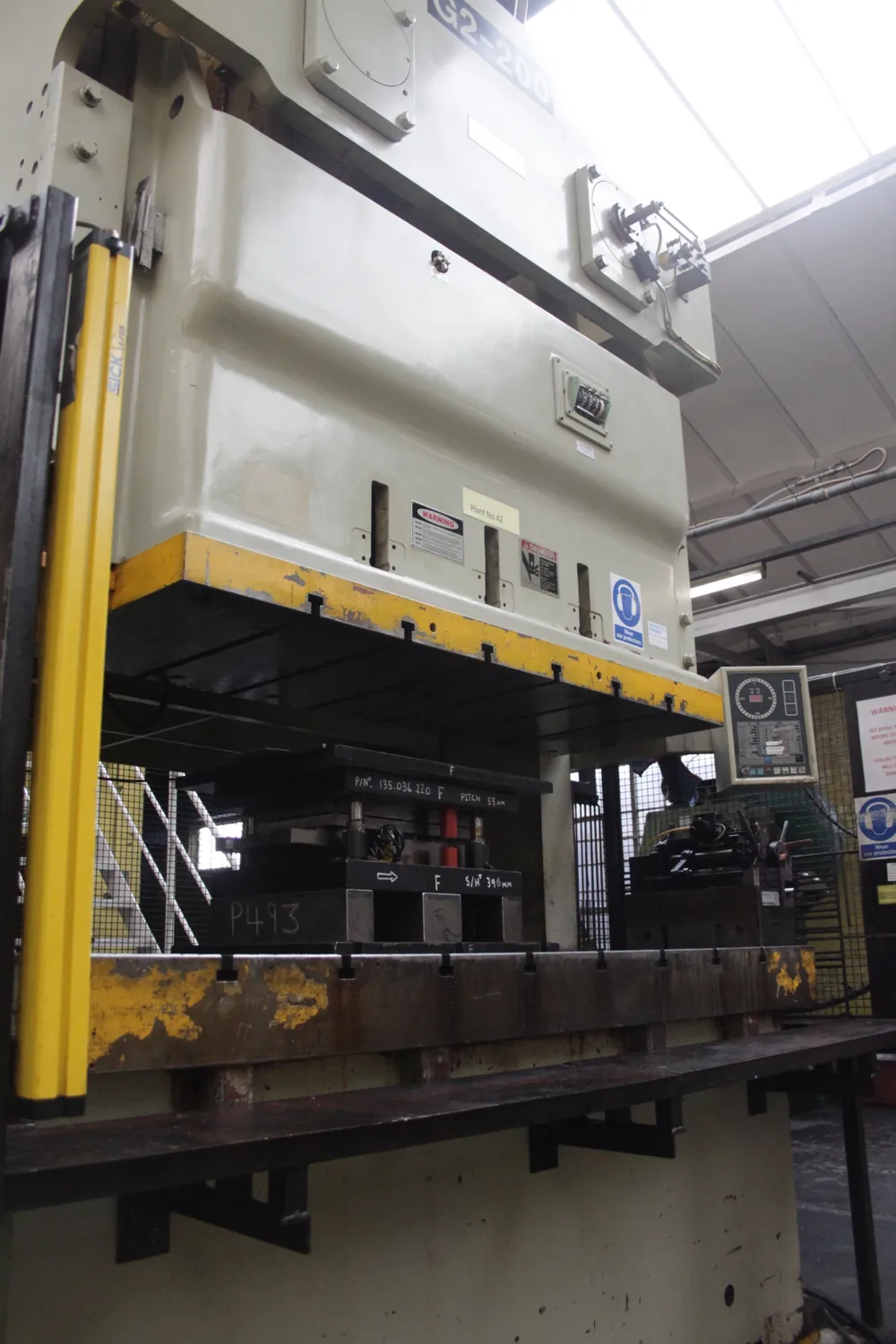
A Chin Fong 200 tonne mechanical press at Genex
Our 200 tonne Chin Fong mechanical press.
Presswork
Press capacityMechanical presses up to 200 tonnes
Tool types runProgression (coil-fed), single action, multi-stage
Material thicknessUp to 5 mm
MaterialsMild steel, stainless steel, aluminium, coated steels (e.g. pre-galvanised)
VolumesA few hundred to hundreds of thousands of parts a year
In-press operationsPierce, notch, form, nut and stud insertion
After pressingProjection and spot welding, robotic MIG, inserting, coating, assembly

Press list

Our mechanical press list

Twelve mechanical presses from 40 to 200 tonnes, so we can match the right press to your part rather than running everything on one machine. A production tool moves to whichever press suits its bed size and tonnage, with coil feed for progression tooling.

Mechanical presses, Oct 2026
MakeCapacityProcessBed sizeFeed
Chin Fong200 tProgression, single action2400 × 840 mmCoil, up to 400 mm wide, 3 mm gauge
Aida160 tSingle action2040 × 760 mmDie cushion, up to 1.6 mm gauge
Seyi160 tProgression, single action1250 × 760 mmCoil, up to 300 mm wide, 3 mm gauge
Chin Fong110 tSingle action1150 × 700 mmDie cushion
Seyi110 tSingle action1150 × 680 mmDie cushion
Rhodes100 tProgression1016 × 850 mmCoil, up to 300 mm wide, 3 mm gauge
Pressix100 tProgression950 × 650 mmCoil, up to 300 mm wide, 3 mm gauge
Bentley80 tSingle action860 × 710 mmDie cushion
HME55 tSingle action785 × 535 mmDie cushion
Bentley50 tSingle action790 × 510 mmDie cushion
Bentley50 tSingle action790 × 410 mmDie cushion
HME40 tSingle action700 × 485 mmDie cushion

Plus a 100 t Amada press brake folding up to 6 mm at 3 m, and a magnetic pan folder for accurate deep folds. Full plant list on request.

02 · Process

How a progression tool makes your part

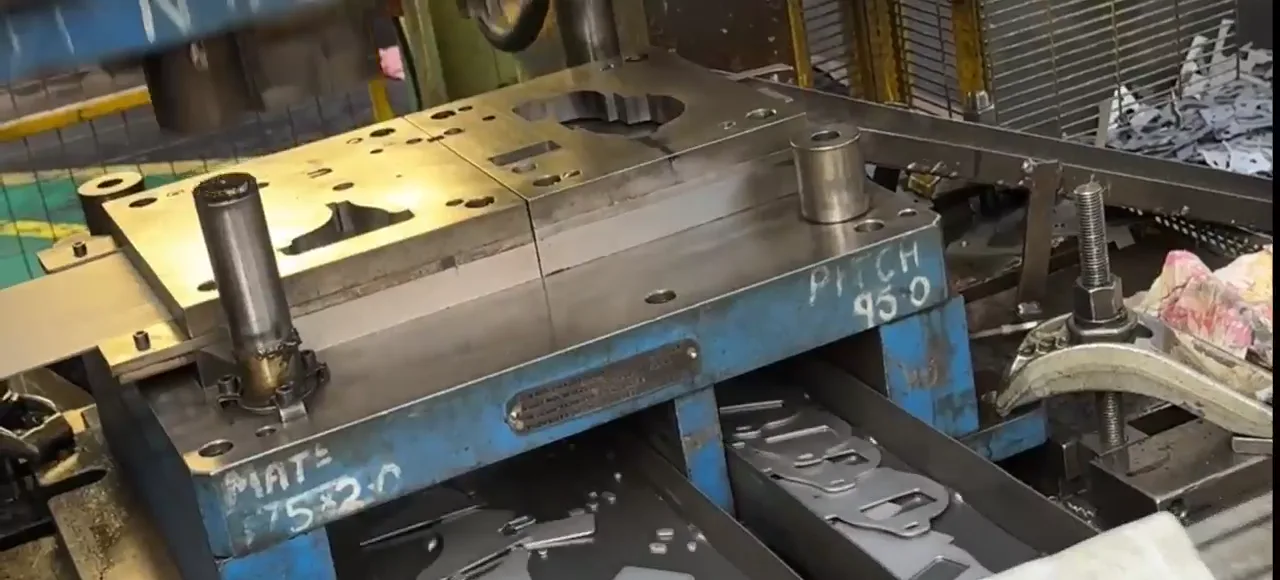
Steel coil feeds through the tool one pitch per press stroke. Each station does one job: pilot holes locate the strip, then the tool pierces, notches, forms and inserts, and the last station cuts the finished part free. A part drops out on every stroke, which is why pressing gives the lowest price per part at volume.

A progression tool running on a Genex press
Live model: the strip indexes one pitch per stroke; pierce, notch, form, nut insert, cut-off.

Simpler parts, or lower volumes, run in single-action tools (one operation per stroke) or multi-stage tools, with the operator moving the part between stages. That keeps tooling cost down when a progression tool wouldn't pay back.

03 · Choosing

Progression, single-action or multi-stage?

Tool typeHow it worksBest for
ProgressionCoil-fed strip, several stations, a finished part every strokeHigh volumes of settled designs
Single actionOne operation per strokeSimple parts, blanks, lower volumes
Multi-stageSeveral separate operations, part moved between themMedium volumes, larger or deeper parts

04 · Route

When pressing makes sense

Pressing pays off once volumes reach several thousand parts a year and the design is settled, because the production tool is a one-off cost spread across every part. Below that, or while the design is still changing, laser cutting and folding is usually cheaper. Near the break point we price both, so you can compare. See pressing vs laser cut and fold.

05 · Design

Design tips for pressed parts

  • Keep holes at least one material thickness across, and at least 1.5× thickness from an edge
  • Keep holes away from bends (at least 2× thickness plus the bend radius), or they'll distort
  • Use generous inside bend radii, especially in stainless, aluminium and high-strength steel
  • Mark the burr side on the drawing if it matters for fit or handling
  • Specify tight tolerances only where the function needs them: they drive tool cost
  • Tell us if nuts or studs are needed: they can often go in during pressing

Starting guidelines, not limits. Tell us what a feature has to do and we'll tell you what's achievable. More in our design guide.

06 · Tooling

Production tooling

We arrange the production tool for your part and quote it separately from the piece price, so you can see exactly what you're paying for. Once it's running, we maintain it in our own toolroom (maintenance is charged), with preventative maintenance that extends tool life and keeps quality consistent from the first part to the last.

Quality

How every part is checked

  • First-off inspection against the drawing before a batch runs
  • In-process checks against the control plan while it runs
  • Final inspection before packing, with material certificates held against the batch
  • Traceability from enquiry to delivery, with customer-specific reports if you need them
  • PPAP Levels 1 to 5 when your customer requires it

Certified to ISO 9001 and ISO 14001. BSI's 2026 audit of our ISO 9001 system found zero non-conformances. More on quality.

Get a price

What to send for a quote

  • A 3D model (STEP) and a dimensioned drawing (PDF or DXF)
  • Material and thickness, and any equivalent grades you'd accept
  • Quantity per order and per year
  • Finish or coating, and any cosmetic faces
  • Critical tolerances, and the approval you need (first-article report or PPAP level)
  • When you need the first parts

Send your drawing for a quote.

Questions

Frequently asked questions

How thick can you press?

Up to 5 mm, on mechanical presses up to 200 tonnes, depending on the material and the size of the part.

What volumes do you press?

From a few hundred parts to hundreds of thousands a year. Coil-fed progression tools are used for the long runs.

Can nuts and studs go in during pressing?

Yes. Nuts and studs can be inserted in the press tool, or as a separate operation in our PEM and projection welding cells.

Can I get prototypes before committing to tooling?

Yes. Prototypes are usually laser cut and folded with no tooling cost, so you can prove the design before the production tool is made.

Which materials can you press?

Mild steel, stainless steel, aluminium and coated steels such as pre-galvanised. Tell us the grade and we'll confirm.

Who maintains the press tools?

We do, in our own toolroom in Walsall, with preventative maintenance and fast response if a tool needs attention.

Can you take over parts from another supplier?

Yes. Send the drawing, volumes and details of the existing tooling, and we'll assess the best way to bring the part to Genex.

Your next project

Let's make it.

Tell us what you need manufactured, assembled and supplied.

Start your enquiry

STEP, DXF or PDFNDA on requestNo obligation

Or talk to the team+44 (0)1922 710050